
In the Netherlands, the debate on eurobonds has narrowed to a choice between full debt mutualisation and preserving national sovereignty. This obscures the fact that eurobonds can take different forms, each suited to different policy objectives.
This article first appeared in Dutch in ESB (Economisch Statistische Berichten), a Dutch platform for economic research and debate.
In brief
• Pooling national debts creates scale and liquidity, but may come at the expense of budgetary discipline.
• Loans from an EU institution to member states enable fast financing, but do not necessarily lead to the best investments.
• Borrowing and investing through an EU institution improves allocation and mobilises private capital, but is limited in scale.
The Dutch debate on joint European borrowing, or eurobonds, is often framed as a matter of principle: full debt mutualisation versus the preservation of national sovereignty. The real question, however, is not whether there should be joint European financing, but in what form and under what conditions. In its recent coalition agreement, the Dutch government stresses that member states bear primary responsibility for their own budgets and that the Netherlands will not underwrite the national debts of other countries. At the same time, the government is open, under conditions, to using existing instruments for joint investment, such as those channelled through the European Investment Bank (EIB), Macro-Financial Assistance, the Ukraine Facility, and joint defence projects (Coalitieakkoord, 2026).
The question is therefore not whether joint European financing should exist, but in what form and under what conditions. This discussion is becoming more urgent given the current financial and geopolitical context, in which major shocks and transitions clearly call for collective action (Benink and Kramer, 2025; Knot, 2025). Joint efforts at the European level make necessary strategic investments in energy security, innovation, and defence possible (Codogno et al., 2020b; Benink and De Hoop Scheffer, 2025).
To help move this discussion forward, this article presents an assessment framework for eurobonds. The framework is not intended to identify a single preferred variant, but to show that different policy goals call for different forms of joint financing. In doing so, we hope to shift the debate from a matter of principle to a strategic weighing of the different eurobond forms against different policy objectives.
Economic challenges facing the European Union
A debate on strategic goals and policy instruments requires acknowledging three major European economic challenges. The first is the pressure on European competitiveness. Draghi (2024) points to a structural investment gap of €750 to €800 billion per year, to be financed through a combination of public and private capital. Following the 2025 NATO summit, a further €320 billion per year related to defence was added to this figure (Bouabdallah et al., 2025). Defence investment needs must be financed almost entirely from public funds, since national security is a public responsibility. This puts even greater pressure on public finances and increases the need to mobilise private capital for Europe’s transitions.
Second, economic interdependence within the eurozone is now so deep that serious problems in one member state can generate real spillovers into others. This was evident during the banking and euro crisis of 2008–2012, and a similar situation could recur, for example through spillovers from France, which faces a high and poorly structured public debt (Fontanel, 2025). Capital flight would trigger a rapid rise in interest rate spreads (Boonstra and Thomadakis, 2020). Because of the monetary union, such a rise becomes a European problem: rising interest rates in one member state spill over directly into bank balance sheets and affect the monetary policy of the European Central Bank.
The final economic challenge, or opportunity, is the weakening position of the dollar. Investor confidence in the US dollar is declining, creating momentum for the euro to position itself as a reserve currency (Wesseling, 2026; Withers and Cruise, 2025). However, fragmentation of national bond markets keeps the euro’s international role stuck at historically low levels (Boonstra and Thomadakis, 2020). Joint European borrowing could contribute to a deep, liquid capital market and, with it, to the creation of a European safe asset able to compete with the US dollar (Codogno and Van den Noord, 2019).
Defining eurobonds
A meaningful discussion of eurobonds requires a clear understanding of the different forms joint borrowing can take. We define eurobonds as debt jointly issued by a European institution, whose interest payments and repayment are jointly guaranteed by EU member states or by countries within the eurozone. Within this definition, we distinguish three main forms.
Pooling national debts or deficits
Pooling existing national debts and/or national budget deficits can, under certain conditions, help create a deep and liquid European bond market. It would also allow countries with higher deficits to raise capital at relatively low cost.
A common concern with pooling national debts is moral hazard: the risk that member states put less effort into keeping their public finances sound because the associated risk is partly borne by others. Several forms of conditional mutualisation have been proposed to limit this risk. One example is the conditional eurobond, under which each country pays a risk premium based on economic fundamentals (Muellbauer, 2013) or on deficit and debt-to-GDP ratios (Boonstra, 2012). Another proposed solution is the blue/red bond mechanism (Delpla and Von Weizsäcker, 2010; Blanchard and Ubide, 2025), which splits national debt in two: a percentage of GDP is issued as safe, jointly guaranteed blue bonds, while debt above that threshold remains national red bonds carrying higher risk premiums.
Experience with the Stability and Growth Pact shows, however, that even strict, pre-agreed rules are difficult to enforce during a crisis (Esteves and Tunçer, 2016). Concerns about moral hazard therefore persist.
European institution borrows, member states invest
A second option involves a European institution issuing debt, with the proceeds lent on to EU member states for specific purposes. Responsibility for how these funds are spent remains with national governments.
This approach was used during the coronavirus crisis. Through SURE and Next Generation EU (NGEU), large-scale EU bonds financed loans and grants to member states (Langedijk et al., 2020). In 2020, a €750 billion package was financed through EU bonds backed by the EU budget, intended to help affected countries strengthen the EU’s structural growth capacity. NGEU was an essential response to an asymmetric shock within a monetary union that lacks the option of national exchange rate adjustment (Codogno and Van den Noord, 2020a).
However, this form also draws considerable criticism. The European Court of Auditors and other observers have identified shortcomings in transparency, results-based management and accountability, largely stemming from the combination of bottom-up projects and national implementation (Codogno and Van den Noord, 2019; Codogno et al., 2020b; European Court of Auditors, 2025). This resulted in limited additionality, since many funded investments would likely have happened anyway, along with relatively large amounts of unspent funds and fragmented projects.
What the issuance of coronabonds did demonstrate was strong market demand for safe, jointly issued debt: demand exceeded supply by a factor of nearly 14, underlining the potential of eurobonds (Boonstra and Thomadakis, 2020). Even so, the ad hoc and temporary nature of these instruments limits their potential as a structural stabilisation tool (Codogno and Van den Noord, 2020a; Skyrman, 2025).
European institution borrows and invests
The third option builds on an existing European structure. Here, a European institution issues debt and invests the proceeds directly in joint European projects. Funds do not pass through national budgets but are selected, assessed and monitored by a European institution such as the European Investment Bank (EIB), based on due diligence processes focused on repayment. The EIB is already one of Europe’s largest AAA-rated issuers, with €457 billion in outstanding loans at the end of 2024 (EIB, 2025a). It also holds substantial reserves and risk-management capacity, allowing it to invest in innovative and strategic projects (Demertzis et al., 2024).
Financing through the EIB falls outside the EU’s Multiannual Financial Framework, so it does not burden the EU budget. A second advantage of this form is its suitability for mobilising private capital. The EIB finances at most half of any project’s costs and draws in additional private capital with every loan: EIB data (2025b) show that six months after a first loan signature, the average portfolio allocation of private investment in the recipient country rose from 3.9 percent to 5.1 percent.
This form also counters a dominant narrative in the current debate, namely that joint borrowing finances consumption spending. An investment-led approach with clear policy goals draws a sharp line between productive investments with genuine European added value on one hand, and generic budgetary headroom on the other.
Assessment criteria
A strategic discussion on financing a resilient European economy requires weighing these instruments against one another. We do so using four assessment criteria, derived from both the economic challenges facing the EU and the advantages and drawbacks raised in the existing debate on eurobonds. First, the combination of Europe’s strategic investment needs (Bouabdallah et al., 2025; Draghi, 2025) and criticism of how funds were spent under programmes such as NGEU (European Court of Auditors, 2025) points to allocation effectiveness: the extent to which joint financing can efficiently serve strategic European priorities.
Second, the frequently raised concern about moral hazard (Esteves and Tunçer, 2016; Boonstra and Thomadakis, 2020), particularly in relation to debt pooling, warrants an assessment of how far different forms reinforce or limit this moral hazard.
Third, the potential to create a European safe asset is often cited as a key advantage of joint debt issuance (Codogno and Van den Noord, 2019), especially given a potentially shifting international role for the dollar, though this potential varies significantly between variants (Withers and Cruise, 2025).
Finally, the scale of Europe’s investment needs shows that public funds alone are not enough (Bouabdallah et al., 2025; Dahlqvist and Riis Andersen, 2025), making the ability of an instrument to mobilise private capital an important criterion. Together, these criteria capture the relevant differences between the three forms of eurobonds.
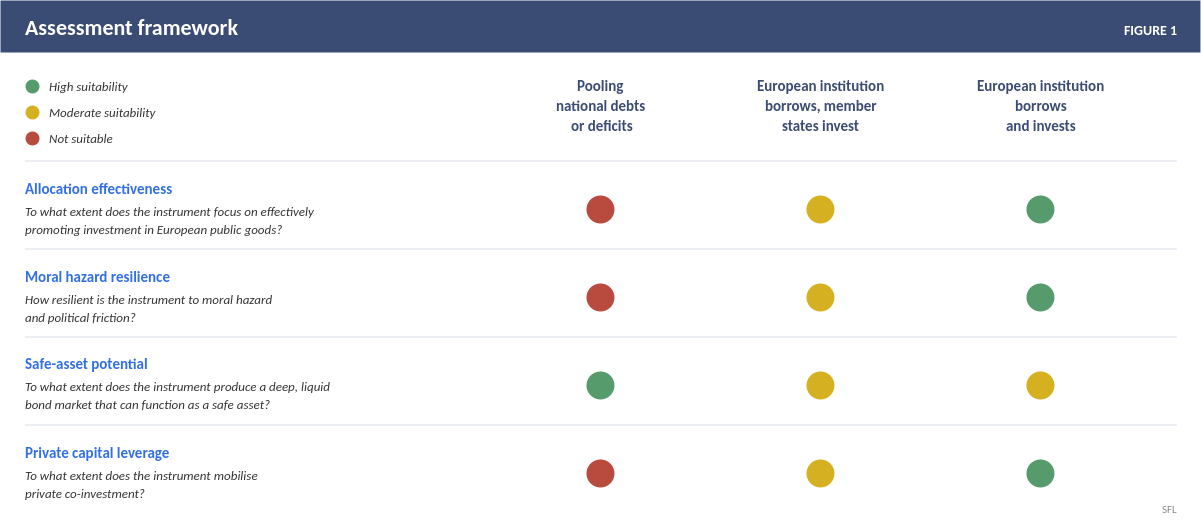
Assessment framework
Figure 1 sets out the three eurobond variants against the four criteria. The figure offers a relative comparison, showing for each criterion which variant performs better or worse, relative to the others, and making clear where the real advantages and risks lie.
The assessment framework in Figure 1 shows that only the pooling of national debts can create a deep, liquid European bond market capable of competing with the dollar as a reserve currency. Only this option offers enough scale and uniformity to function as a safe asset. At the same time, Specker et al. (2026) show that this safe-asset potential can only be realised alongside European reforms. Deepening the savings and investments union and reducing capital market fragmentation are necessary to broaden the investor base for EU bonds and deepen liquidity. Despite its strategic value, this option faces considerable resistance in the current political debate.
The second option, in which a European institution borrows while member states invest the proceeds themselves, scores moderately across the criteria. It offers an advantage for macro-stabilisation and rapid crisis response: earlier instruments such as SURE, NGEU and the Ukraine Facility show that the EU can mobilise capital quickly and cheaply in crisis conditions. For strategic investment needs such as defence, energy and innovation, however, this instrument is less suitable. National implementation can lead to diverging priorities, poor absorption, and an insufficient contribution to the EU’s competitive position. The leverage on private capital is also limited, since project selection remains fragmented. This option therefore performs adequately across the board: useful in a crisis, but not optimal on any single criterion.
The third form involves loans issued through a European institution such as the EIB that both borrows and invests. This form is best suited for promoting investment in European public goods, such as energy networks, innovation and digitalisation. This European project-based approach mitigates the problems that arose under NGEU from national distribution of funds, since the focus lies explicitly on projects with demonstrable European added value. The option scores well on allocation effectiveness and private capital mobilisation. Its safe-asset potential is lower, however, given the scale it can currently reach, though the EIB’s AAA status offers a reliable foundation that could grow over time. The combination of political feasibility and strategic focus makes this form likely the most achievable in the current political landscape.
Conclusion
Looking at the current economic reality of the eurozone, we see substantial investment needs, deep financial interdependence, and the absence of a European safe asset. Joint financing can play a role in addressing these challenges.
The eurobond is not a single, fixed concept but a spectrum of instruments that differ in purpose and risk. Several types of eurobonds have already been issued, and it is time for a careful weighing of the options. The right form depends on the objective. Pooling existing debts and/or new budget deficits offers the greatest safe-asset potential. Ad hoc loans through an EU institution, with countries investing the proceeds themselves, deliver rapid stability in a crisis but are too fragmented for long-term structural European investment. A promising middle path is a model in which a European institution both borrows and invests, combining strategic feasibility with a clear focus on allocating funds to European public goods.
The coalition agreement leaves room to weigh different forms and conditions (Coalitieakkoord, 2026). The time has come to approach the eurobond debate not as a matter of ideology, but as a strategic question aimed at building a resilient European economy.
References
Benink, H. and J. de Hoop Scheffer (2025) Nederland moet eindelijk af van de eurobond-reflex. Het Financieele Dagblad, 22 October.
Benink, H. and B. Kramer (2025) Europese schulduitgifte cruciaal voor veiligheid. Het Financieele Dagblad, 11 February.
Blanchard, O. and Á. Ubide (2025) Now is the time for Eurobonds: A specific proposal. Peterson Institute for International Economics, Publication, 30 May.
Boonstra, W. (2012) Conditionele Eurobonds als overgangsregime. ESB, 97(4630), 134–137.
Boonstra, W. and A. Thomadakis (2020) Creating a common safe asset without eurobonds. ECMI Policy Brief, 29. Available at www.ceps.eu.
Bouabdallah, O., E. Dorrucci, C. Nerlich et al. (2025) Time to be strategic: How public money could power Europe’s green, digital and defence transitions. ECB Blog at ecb.europa.eu, 25 July.
Coalitieakkoord (2026) Aan de slag: Bouwen aan een beter Nederland. Dutch coalition agreement 2026–2030. Available at www.kabinetsformatie2025.nl.
Codogno, L. and P. van den Noord (2019) The rationale for a safe asset and fiscal capacity for the Eurozone. LEQS Paper, 144/2019. Available at www.lse.ac.uk.
Codogno, L. and P. van den Noord (2020a) Assessing Next Generation EU. LEQS Paper, 166/2020. Available at www.lse.ac.uk.
Codogno, L., P. van den Noord and R. Beetsma (2020b) Next Generation EU: Europe needs pan-European investment. VoxEU Blog, 9 November. Available at cepr.org.
Dahlqvist, F. and J. Riis Andersen (2025) Private capital: The key to boosting European competitiveness. McKinsey & Company Article, 1 April.
Delpla, J. and J. von Weizsäcker (2010) The Blue Bond proposal. Bruegel Policy Brief, 2010/03.
Demertzis, M., D. Pinkus and N. Ruer (2024) The European Investment Bank can afford to take more risks. Bruegel Analysis, 22/2024.
Draghi, M. (2024) The future of European competitiveness: A competitiveness strategy for Europe. European Commission Report, September. Available at commission.europa.eu.
EIB (2025b) EIB Global Impact Report 2024/2025. European Investment Bank, 30 June.
Esteves, R.P. and A.C. Tunçer (2016) Eurobonds past and present: A comparative review on debt mutualization in Europe. Review of Law & Economics, 12(3), 659–688.
European Court of Auditors (2025) Review 02/2025: Performance orientation, accountability and transparency: Lessons to be learned from the shortcomings of the RRF. European Court of Auditors, Review, 02.
European Investment Bank (2025a) Financial Report 2024. EIB, 7 May.
Fontanel, J. (2025) The political, economic and social fractures of France at the dawn of the year 2025. HAL, hal-04949471. Available at hal.univ-grenoble-alpes.fr.
Knot, K. (2025) Interview with Klaas Knot in EW. DNB News, 21 March.
Langedijk, S., M. Verwey and R. Kuenzel (2020) Next Generation EU: A recovery plan for Europe. VoxEU Column, 9 June. Available at cepr.org.
Muellbauer, J. (2013) Conditional eurobonds and the eurozone sovereign debt crisis. Oxford Review of Economic Policy, 29(3), 610–645.
Skyrman, V. (2025) Mind the gap: Can Europe afford its green and digital future? Article at www.socialeurope.eu, 13 June.
Specker, I., R. van der Voort and H. van de Burgwal (2026) Rentevoordeel EU-obligaties afgenomen. ESB, 111(4854), 86–87.
Wesseling, J. (2026) Een grotere internationale rol van de euro moeten we verdienen. ESB, 111(4849).
Withers, I. and S. Cruise (2025) Europe gains traction amid doubts over US assets, global money managers say. Reuters News, 21 May.