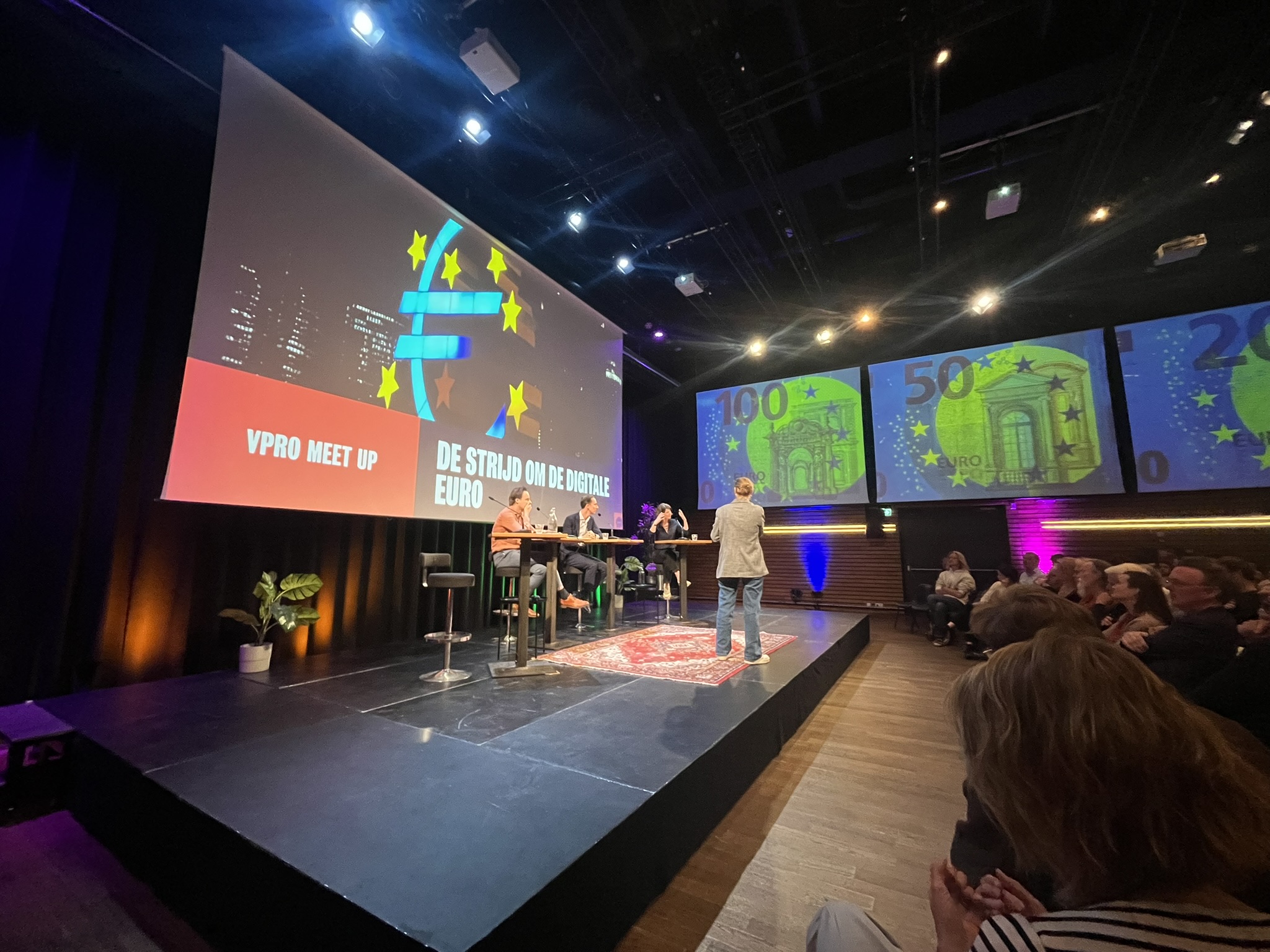
In June the European Parlement will vote on the future of the digital euro. Yet the general public remains largely unaware of what it actually is, what problem it is meant to solve, and what is at stake if we get it wrong. On Friday 8 May, writer Thomas Bollen, Menno Broos of De Nederlandsche Bank, and Member of the European Parliament Lara Wolters (PRO) gathered at Pakhuis de Zwijger to address precisely these questions.
At the public evening, organised by Pakhuis de Zwijger in partnership with the Sustainable Finance Lab and Triodos, the speakers reflected the role of public money and on the rationale behind the digital euro: strategic autonomy. Given political instability, Europe cannot afford to remain dependent on payment infrastructure located outside its borders, Menno Broos explained.
The current proposal sets a maximum of 3,000 euros per account, a limit that Thomas Bollen, author of Geld genoeg, maar niet voor jou, considers far too restrictive. “If the limit stays this low, nobody is going to use the account. What would be the objection to simply raising it to 100,000 euros?” Menno Broos offered a nuance: the risks associated with money are greatest in its payment function, not in its savings function. It is also possible to arrange for automatic top-ups the moment a balance drops below 3,000 euros. SFL member Harold Benink, present in the audience, added that such a cap this low would be unworkable for business owners.
The bank run argument
Broos elaborated on the reasoning behind the limit: the risk of a bank run. Should people move their money en masse from commercial banks to a digital euro, the system could be destabilised. Yet this argument has its limits, Broos acknowledged: bank runs are more likely to be triggered by social media than by a new payment instrument, as the collapse of Silicon Valley Bank in 2023 demonstrated.
Limit and accessibility remain contentious issues
Lara Wolters offered a glimpse into the lobbying landscape in Brussels. Considerable effort has gone into watering down the digital euro. Fernando Navarrete Rojas, the lead rapporteur for the digital euro in the European Parliament, initially sought to restrict it to an offline-only system. Following sharp criticism, that position was revised, but the disputes over the limit and accessibility continue.
Moderator Natasja van den Berg referred to the open letter by SFL, signed by seventy academics, warning against an overly stripped-back version of the digital euro. Do initiatives of this kind make a difference? Wolters: “Yes. It creates movement. The more voices, the better.”
Who is in control?
Ultimately, Wolters argued, the debate is about something more fundamental than technology: “It comes down to power. Who is in control? The financial crisis showed that it is not fair for banks to take risks whilst ordinary people bear the consequences. Banks warn of a bank run, yet in the same breath they speak of market competition. If they truly believe in that, they should also accept that people may choose not to bank with them because the risks are too great.”
The full conversation, which also zooms in on privacy and the role of stablecoins, can be viewed below (in Dutch).