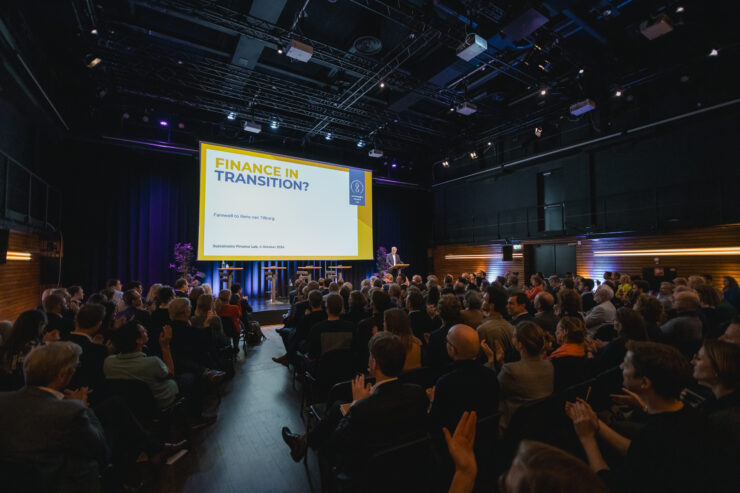
On December 1, 2025, Sustainable Finance Lab hosted a webinar to explore a critical question: Is the European Central Bank’s (ECB) monetary policy helping or hindering the energy transition?
Two new research papers, presented by Andrea Polo (Luiss University/ECB) and Mark Sanders (Maastricht University), offered complementary but distinct perspectives on how interest rates and bank lending practices influence the deployment of green investments. The discussion revealed that while banks are beginning to price climate risk for greener firms in general, periods of monetary policy tightening have inadvertently slow investments in more specific market segments such as renewable energy projects.
The key takeaways from the discussion are:
- Banks now price climate risk, but the effect is modest. Euro area banks charge 4-10 basis points more to high-emission firms and offer 16 basis points discounts to those with decarbonization commitments (Altavilla et al., 2024). While this signals progress, the “green spread” may not be large enough to accelerate the transition at the required pace.
- Monetary tightening disproportionately hurts renewables. A 25 basis point ECB rate hike could reduce new wind installations by 8% and solar PV additions by 26.5%, increasing the fossil fuel share in the energy mix by 0.6 percentage points (Serebriakova et al., 2025).
- Technology maturity matters. Less mature, capital-intensive renewables (e.g., solar PV, onshore wind) are far more sensitive to interest rate changes than fossil fuels or hydro, due to their reliance on external finance and higher upfront costs.
- Flanking policies could mitigate negative impacts. The ECB’s mandate supports targeted measures, such as differential interest rates, green bond purchases, or subsidies, to ensure monetary tightening does not derail the energy transition.
- Data gaps limit progress. Current taxonomies and loan data lack granularity, risking misaligned incentives, such as discouraging lending to transitioning firms.
You can download Andrea Polo’s presentation here and Mark Sanders’ presentation here.